
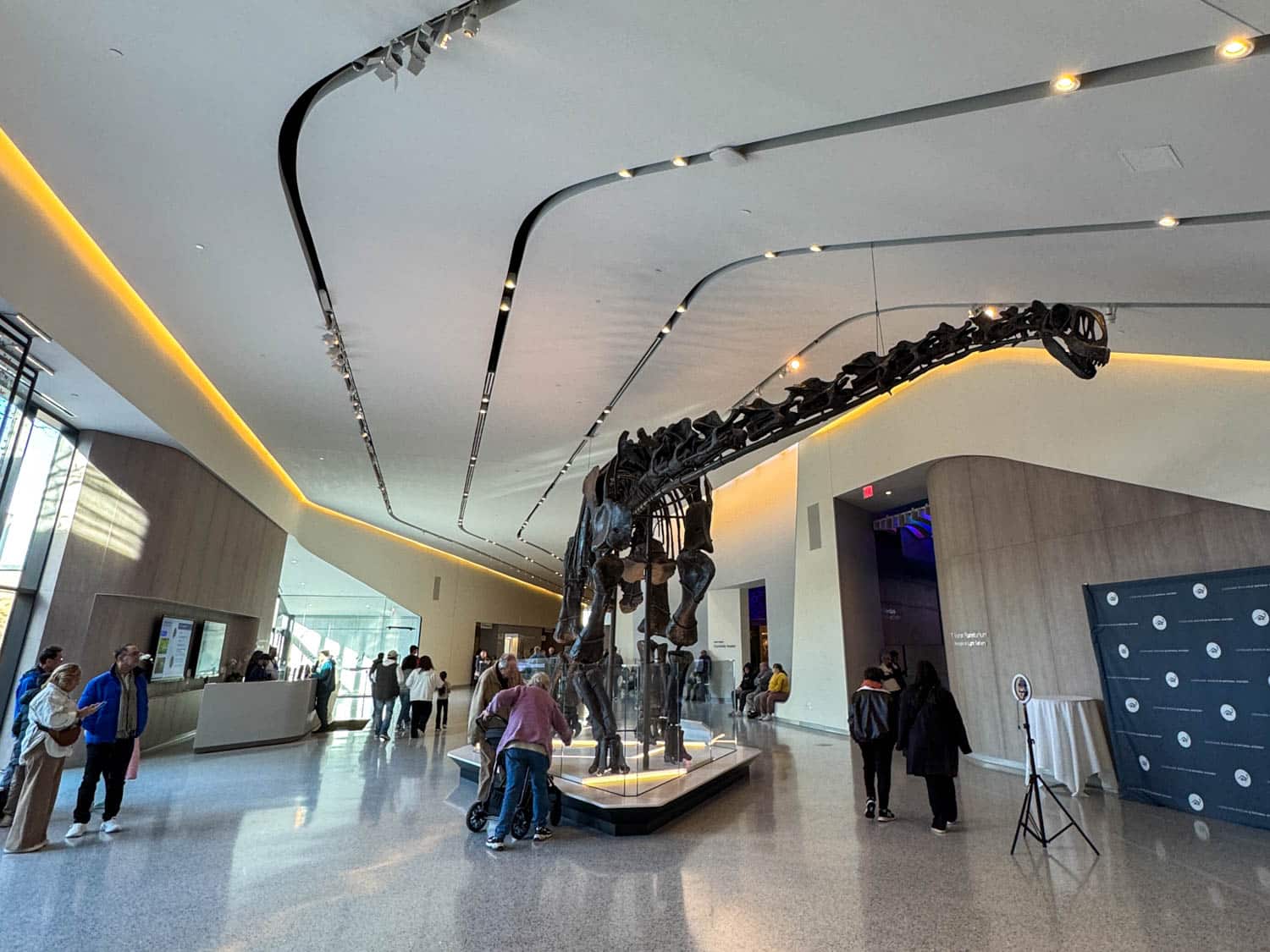
The Cleveland Museum of Natural History (CMNH) underwent a massive and complete $150 million transformation in the last couple of years, and is finally fully reopen to the public!
This museum has always been a great one in Cleveland, but is even better now with its makeover!
Whether you are looking for things to do in Cleveland on a rainy day, or you want to continue exploring Cleveland’s best museums, a stop at the Cleveland Museum of Natural History is a must.
A little CMNH history
The Cleveland Museum of Natural History was founded in 1920 for education and research in geology, paleontology, biology, and astronomy, among many other fields of science.
Its origins began as a part of ARK. ARK was a place where Cleveland’s scholars gathered and created several cultural and historical institutions in the area. Originally located in the northeast corner of Public Square in a small building, the visitors called it “ARK” for the many taxidermied animals on display. Members of ARK eventually created the Cleveland Academy of Natural Sciences in 1845, which eventually evolved into the Cleveland Museum of Natural History.
While ARK disappeared by the 1900s, Harold T. Clark gathered 26 civic leaders together to create the Cleveland Museum of Natural History. The museum started in an office building downtown, and was quickly moved to Hanna House in 1922. Then, as it began to outgrow the mansion in the 1950s, the Cleveland Museum of Natural History was created on Wade Oval in University Circle, where it still stands today.
Now CMNH is home to exhibits ranging from earthquakes to space to live animals of Ohio.
To help make your time at the Cleveland Museum of Natural History as memorable as possible, here are some of the top things you’ve got to see. This list includes amazing exhibits and hidden gems to enjoy during your visit to the museum.
Many museum favorites got moved around during the renovation, but they’re all still there if you know where to look!
10 Must-Sees at the Cleveland Museum of Natural History
1. Happy the dinosaur
Visitor Hall
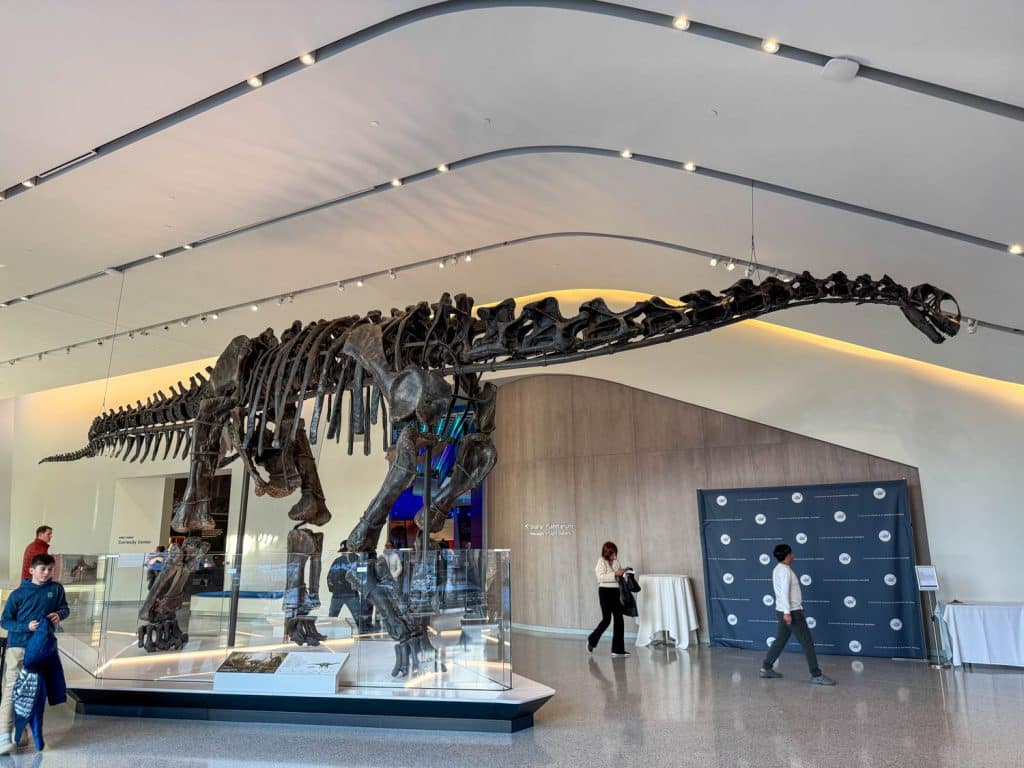
The museum renovation re-imagined the CMNH visitor experience, with a new focus put on the entrance hall that all the other exhibits branch off from. This new Visitor Hall is home to some of the museum’s most iconic specimens.
And the first thing you’ll see when you enter is Happy, or the massive Haplocanthosaurus delfsi dinosaur skeleton.
“Happy” has such a cool backstory. Back in the 1950s when CMNH was moving into its new, larger home on Wade Oval, the museum decided it needed a dinosaur. So they sent college student Edwin Delfs on a mission out west to “find a dinosaur.” And guess what? He did!
The Haplocanthosaurus delfsi was the first of its kind ever discovered (hence why it’s named after Delfs), and Happy is one of the only known specimens of its kind that is complete enough to be displayed like this.
2. Balto
Visitor Hall

Many remember Balto as the lead dog in a dog sled team that delivered the life saving serum during a diphtheria outbreak to Nome, Alaska in 1925, a place only reachable during the winter via the Iditarod Trail. (Thanks, Disney.)
Balto and his team were successful and quickly became famous across the US. Only now I know what you’re thinking… why is he at the Cleveland Museum of Natural History?
Balto and his team became heroes overnight, but were quickly forgotten. As the sled dogs were neutered and couldn’t make money from breeding, they were sold to perform on the vaudeville circuit until they were purchased for a “dime” museum in Los Angeles.
It was there that Cleveland businessman George Kimball discovered them and saw how mistreated they were. He offered to pay $2,000, which he had to raise in just two weeks to purchase the dogs. The Balto Fund was created and broadcast nationwide, and in just 10 days he was able to purchase the dogs and bring them to Cleveland to live out their days at the Brookside Zoo (today’s Cleveland Metroparks Zoo) in comfort. They received a hero’s welcome and parade upon arrival in Cleveland.
Balto lived to be 14 years old before passing in 1933. He was then preserved and sits proudly on display in the new Visitor Hall at the Cleveland Museum of Natural History.
3. Lucy
Visitor Hall
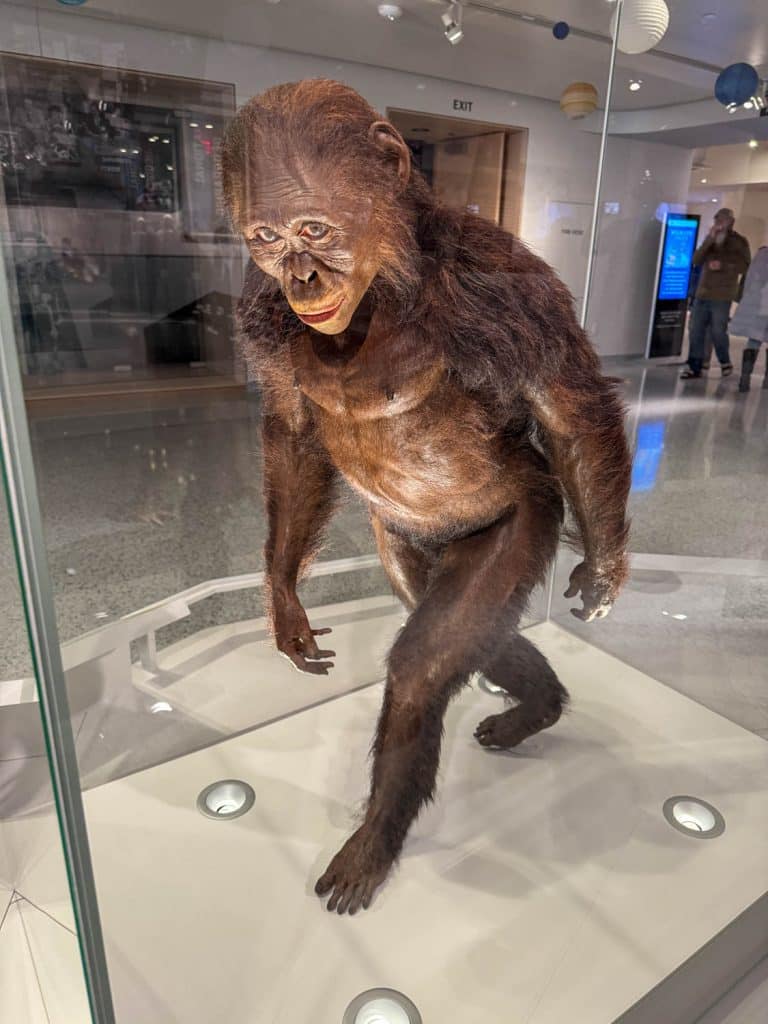
Lucy is the name for the Australopithecus afarensis skeleton that was discovered in Ethiopia in 1974. What makes her so unique to Cleveland is that CMNH’s curator at the time, Dr. Donald Johanson, is the one who led the team that found her!
At the time, finding Lucy was an incredible discovery because she was the most complete and oldest human ancestor skeleton ever found at 3.2 million years old! Her discovery is still groundbreaking in learning about human evolution.
While her actual skeleton isn’t on display at the Cleveland Museum of Natural History (it’s safely in storage at the National Museum of Ethiopia in Addis Ababa, Ethiopia), the museum did create a cast of her skeleton as well as a reconstructed version of what she would have looked like in prehistoric times.
There’s a special “Celebrating Lucy” exhibit on at the museum through mid-March 2025 to celebrate the 50th anniversary of her discovery.
4. Dunk
Visitor Hall, and also the Evolving Life wing
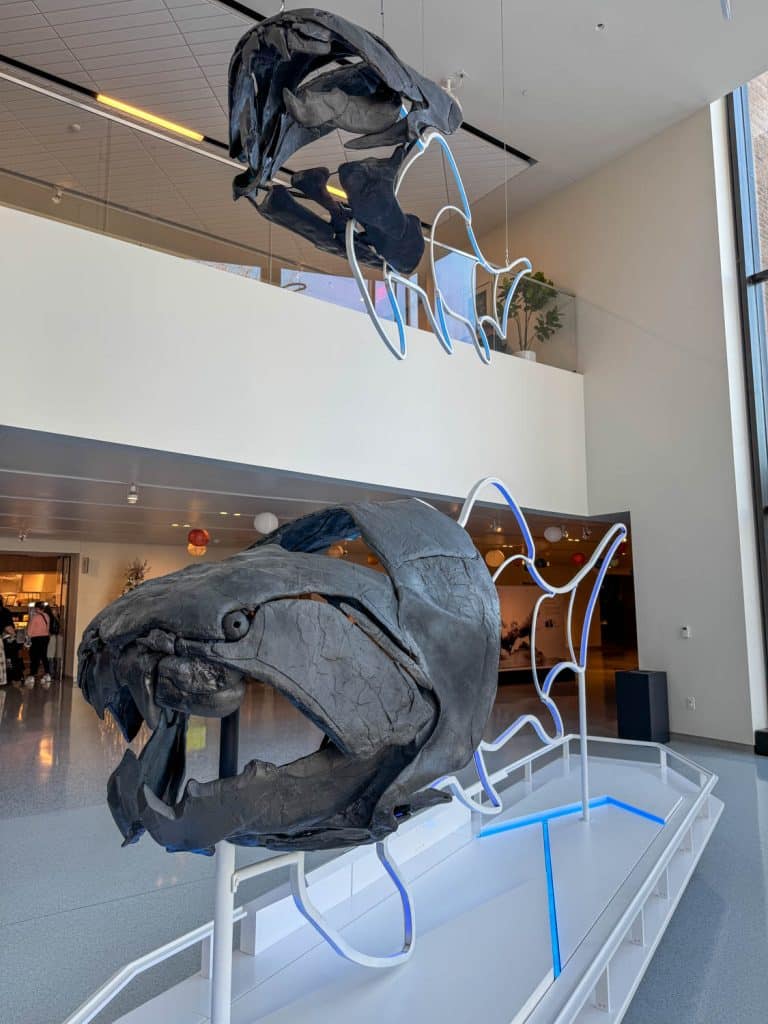
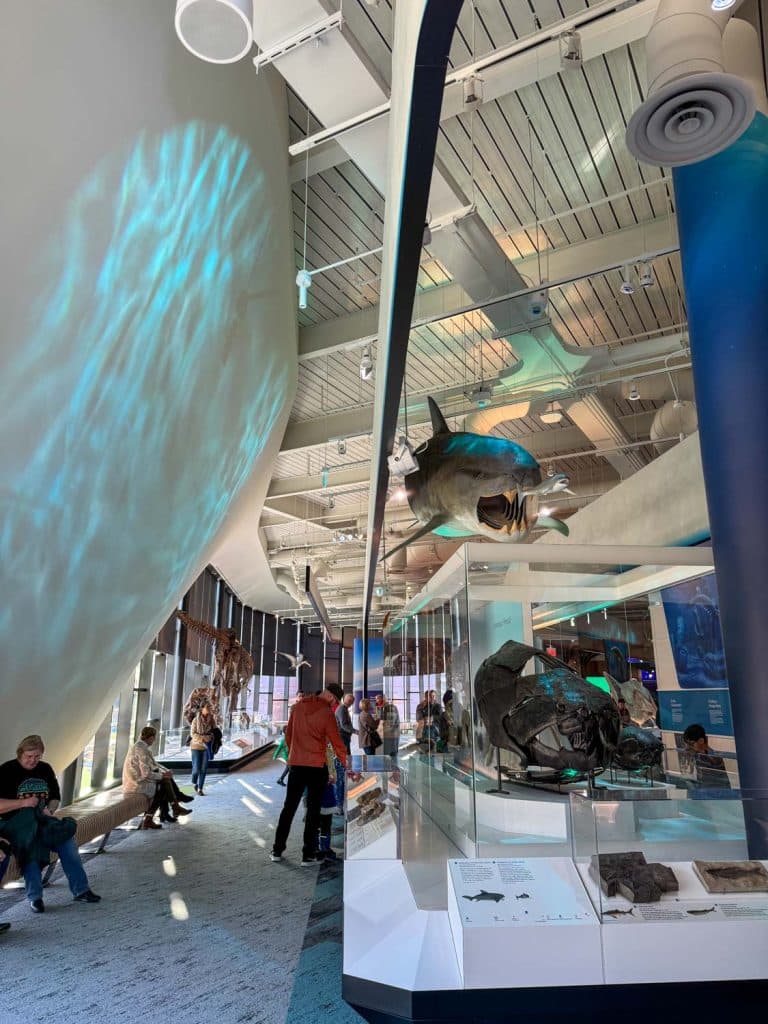
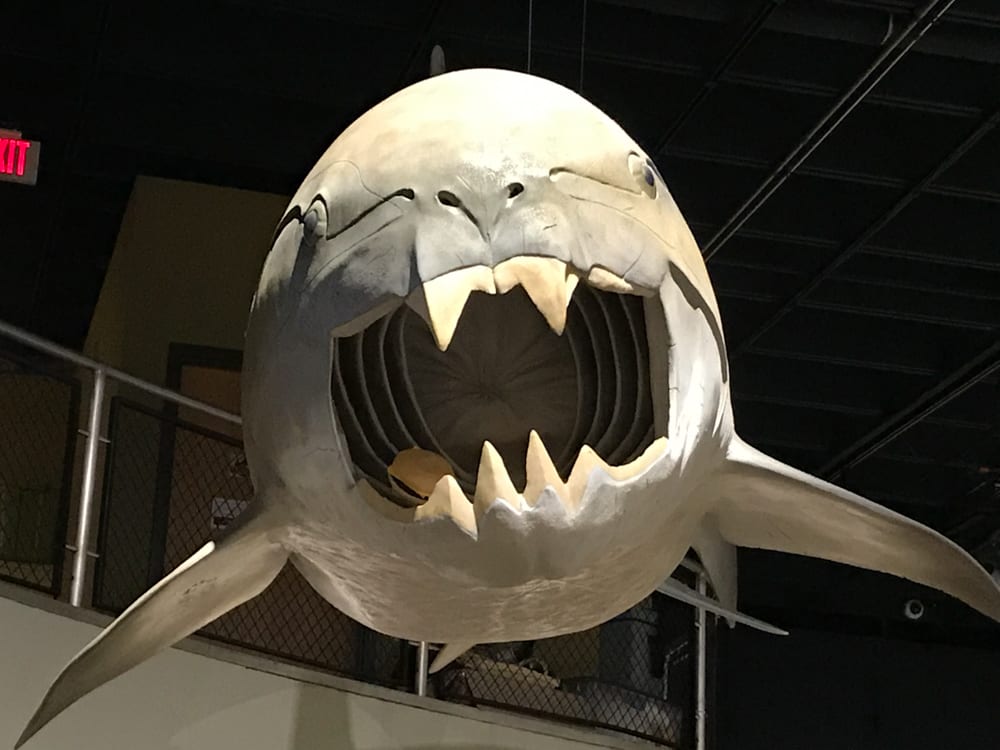
Once upon a time, the area where Cleveland currently sits used to be a tropical sea! And one of the biggest things swimming around in that sea was Dunkleosteus terrelli, a giant armored fish.
The Dunkleosteus terrelli, AKA “Dunk,” was an apex predator roughly 20 feet long and weighing more than 1 ton. Dunk is the official state fossil fish of Ohio, and you can find some of their skulls displayed in the CMNH Visitor Hall, plus a larger Dunk exhibit inside the Evolving Life wing of the museum.
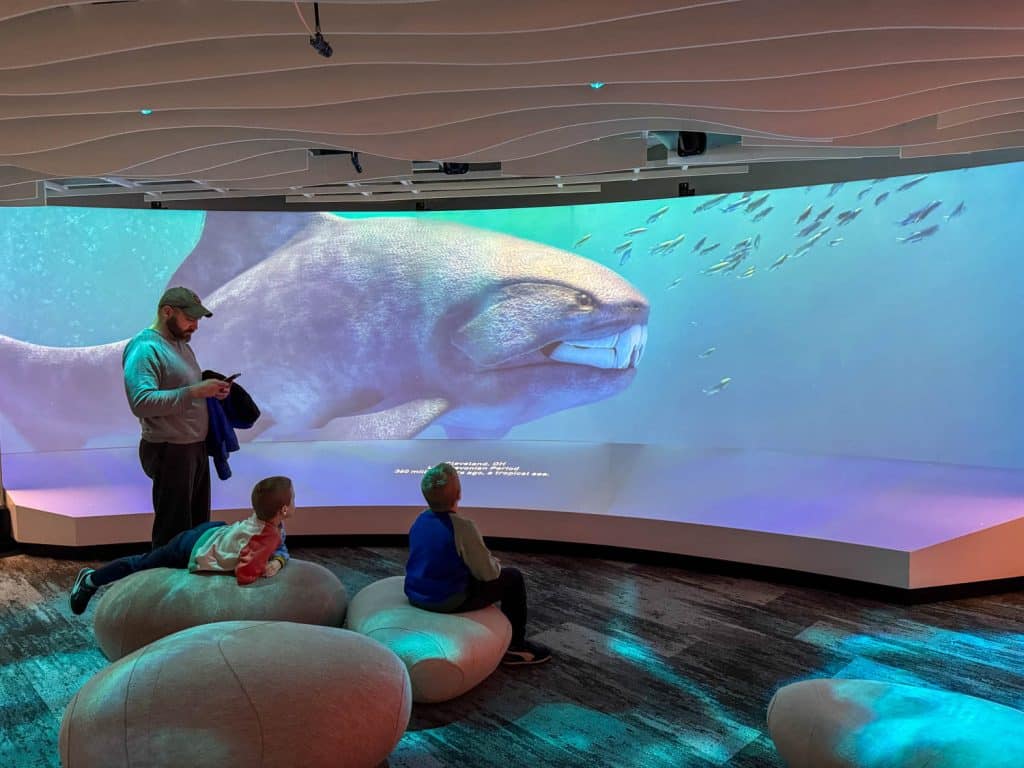
CMNH has unique ties to “Dunk” as well, as Cleveland Museum of Natural History scientists were responsible for unearthing a large number of Dunkleosteus fossils. Because of this, CMNH is one of the best places to learn about this fascinating prehistoric predator.
5. The Evolving Life wing
Evolving Life wing, past the museum store and cafe
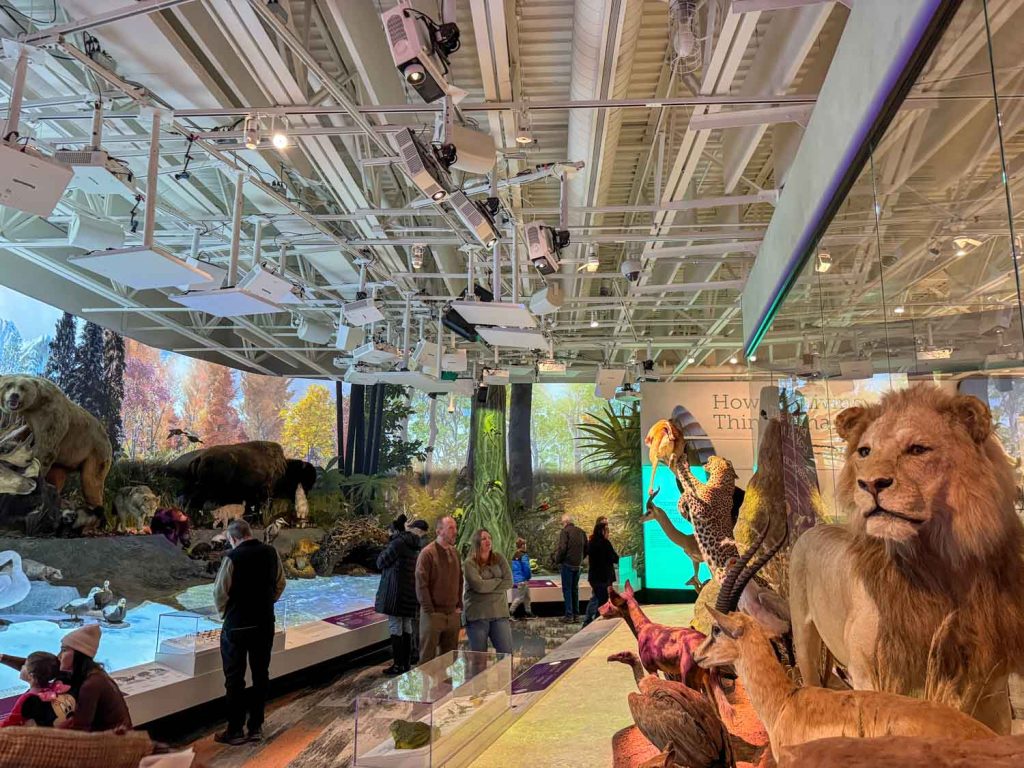
The museum’s brand new Evolving Life wing deserves a mention of its own on this list, as it’s really cool! It covers everything from human evolution (which Lucy fits into) to how all life on Earth is interconnected.
There are many displays in this wing, including some interactive ones!
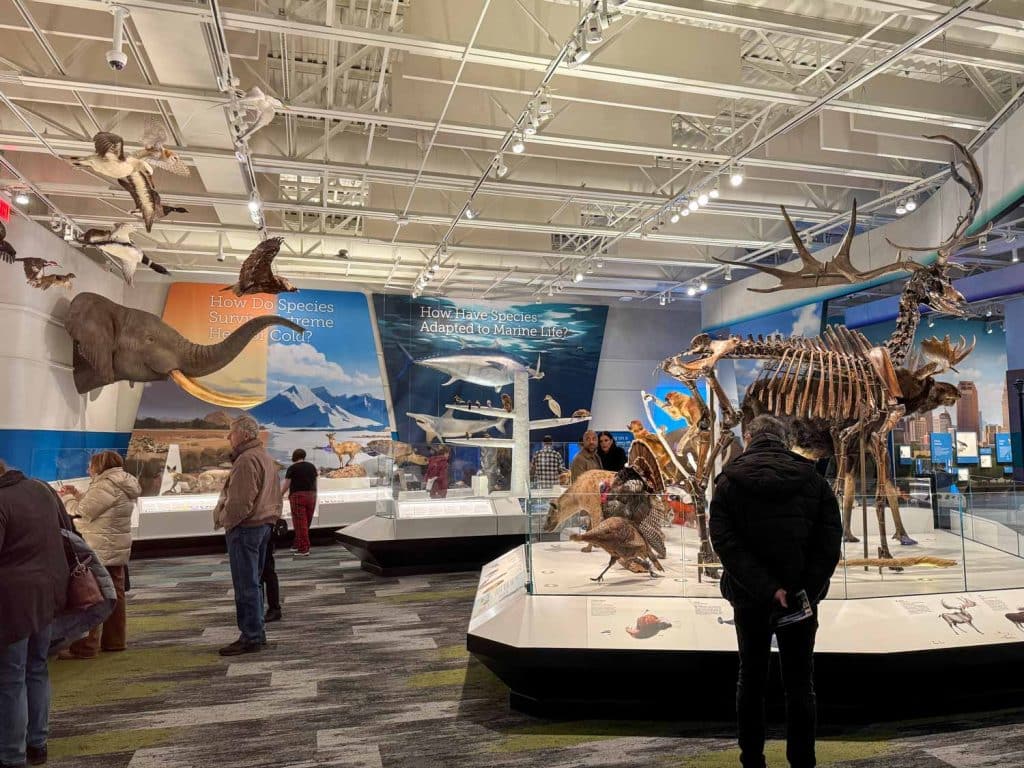
My favorite (new) part is in the far corner of the wing, where taxidermied animals from various biomes are set up in scenes. You can wave your hand over different markers, and directional speakers play information about different creatures and how they’ve adapted to their environments.
6. Perkins Wildlife Center & Woods Garden
Outside, entrance is next to the Evolving Life wing
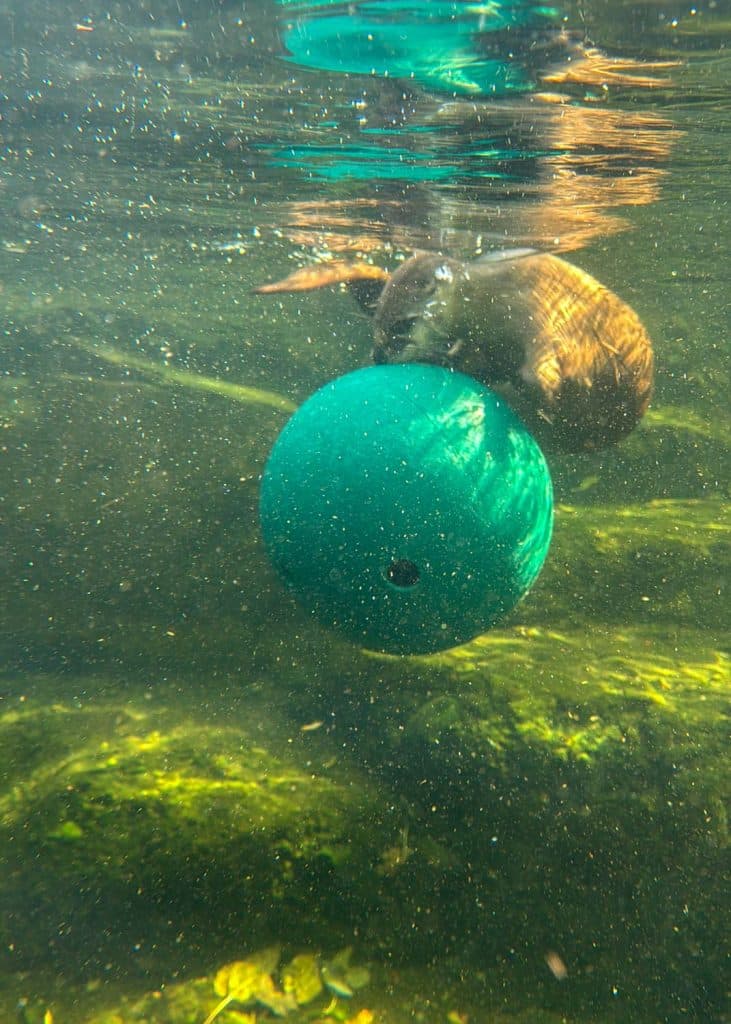
Speaking of animals in their environments… CMNH has live wildlife outdoors in the Ralph Perkins II Wildlife Center & Woods Garden, too. The wildlife center focuses on local Ohio animals including coyotes, foxes, raccoons, bobcats, river otters, and many birds as well as the ecosystems they live in. They’re all rescued animals that cannot be released back into the wild.
You can walk through the space to see all the various animals, and CMNH wildlife specialists also give talks and presentations a few times per day.
7. Shafran Planetarium & Mueller Observatory
Near the Dynamic Earth wing
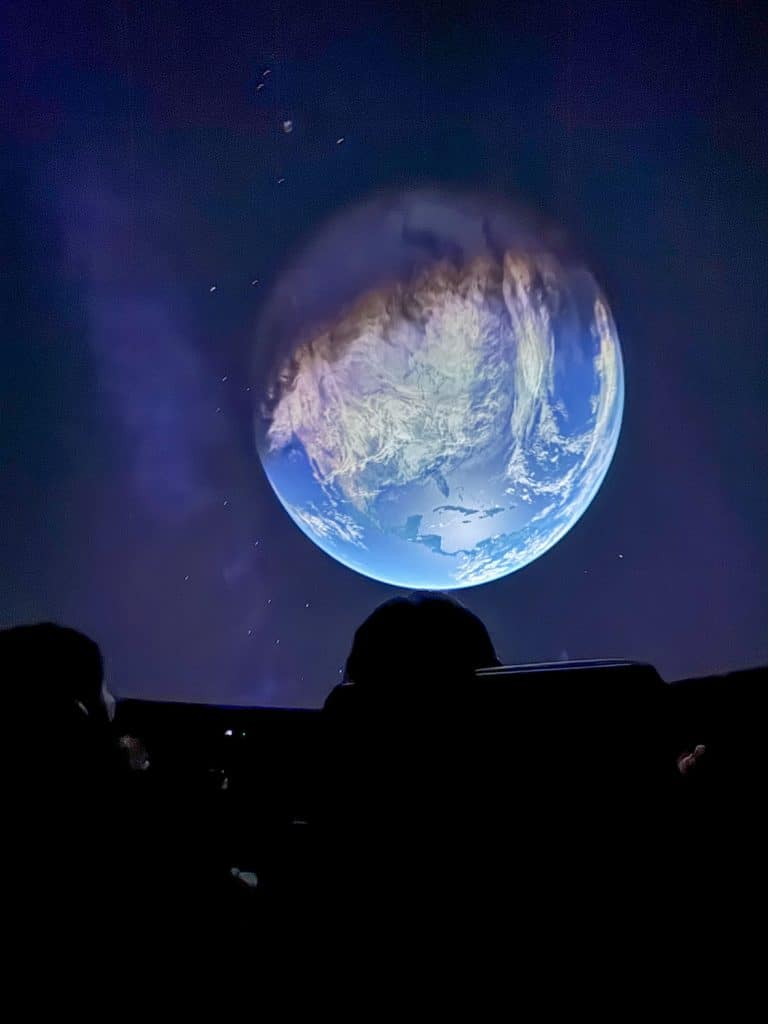
The Shafran Planetarium also underwent a full renovation of its dome, and you can enjoy new astronomy programs and presentations. (Exact shows and times to come!)
Aside from the planetarium and observatory, there is also an exhibit in front of this area to learn about space and how we study it.
8. Dynamic Earth wing
Off the Visitor Hall behind Happy

The new Dynamic Earth wing covers everything from life cycles to earthquakes to even a little bit of chemistry. There are several hands-on exhibits here, along with more fossils, including one of a T-Rex.
The CMNH’s earthquake simulator has been re-imagined here, too. Learn about plate tectonics as you stand on a “fault” line and see what different magnitudes of earthquake feel like.
9. Moon Rock From the Apollo 12 Mission
Visitor Hall
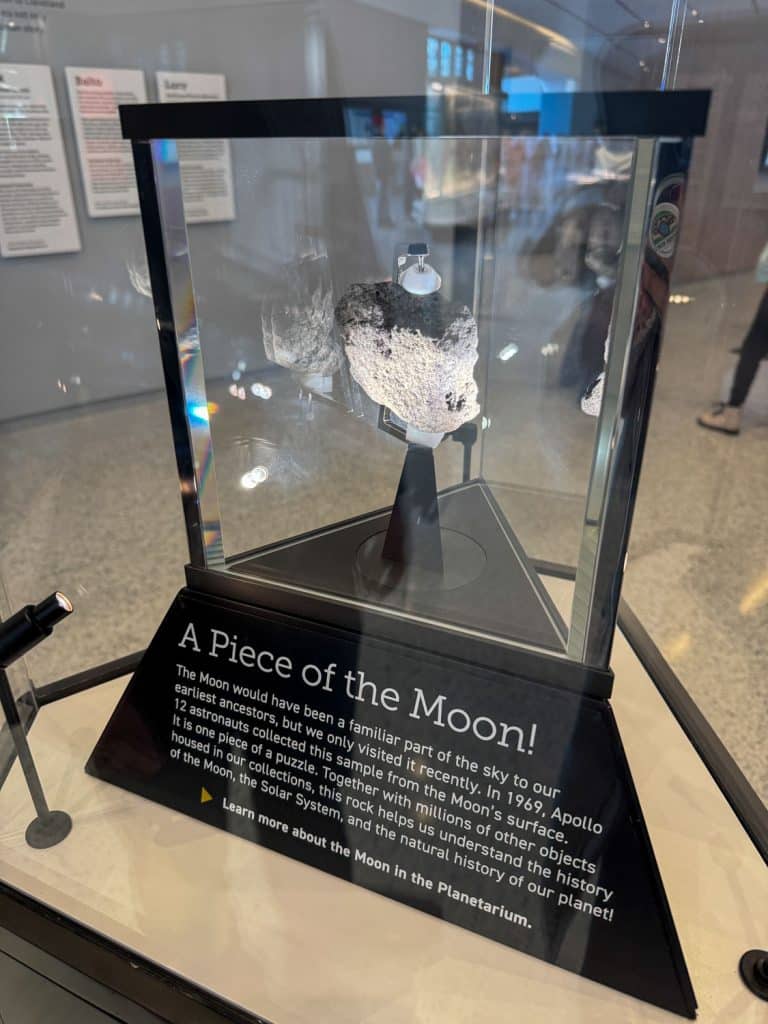
Located in a prominent spot in the new Visitor Hall sits a moon rock from the Apollo 12 mission. Yes, a real piece of the Moon!
Created 3.3 billion years ago by a lava sheet that solidified on the Ocean of Storms on the Moon, this rock was broken up by a meteorite that hit 228 million years ago. On November 20, 1969, Alan Bean picked it up and now it resides at the Cleveland Museum of Natural History.
10. Find the Hidden Easter Eggs Around the Museum!
All Over the Museum
Okay, this isn’t exactly an exhibit to see, but the Cleveland Museum of Natural History loves to hide things throughout the museum to find!
First of all, outside the Smead Discovery Center on the lower level of the museum there is a display of beetles on the wall. Amongst them is a tiny little Volkswagen beetle!
Also, there are always at least 4-5 plastic cheeseburgers hidden throughout the museum at all times. (And yes, this is a tradition they’ve carried over into the remodeled museum!)
Pro-tip: If you are visiting with kids, be sure to also visit the Smead Discovery Center for interactive activities like the play fossil dig!
Tips For Visiting The Cleveland Museum of Natural History
If you are planning a visit to CMNH, here is what you need to know!
1. Museum Admission and Parking Fees
To visit the Cleveland Museum of Natural History, the admission is $25 for adults aged 19+ in advance (or $28 at the door), and $18 for college students with a student ID, youth aged 2-18, and seniors aged 61+ ($21 at the door). Children 2 and younger are free.
This does not include the fee for the planetarium shows or 3-D movies if you choose to do any of those (add one for $7, or upgrade to an All-Access Pass for $35).
Also, there is a parking garage at the entrance, and it is $12 for 2 hours to park there plus $1 per hour over that, with a daily maximum of $18. You can also use the metered parking in Wade Oval.
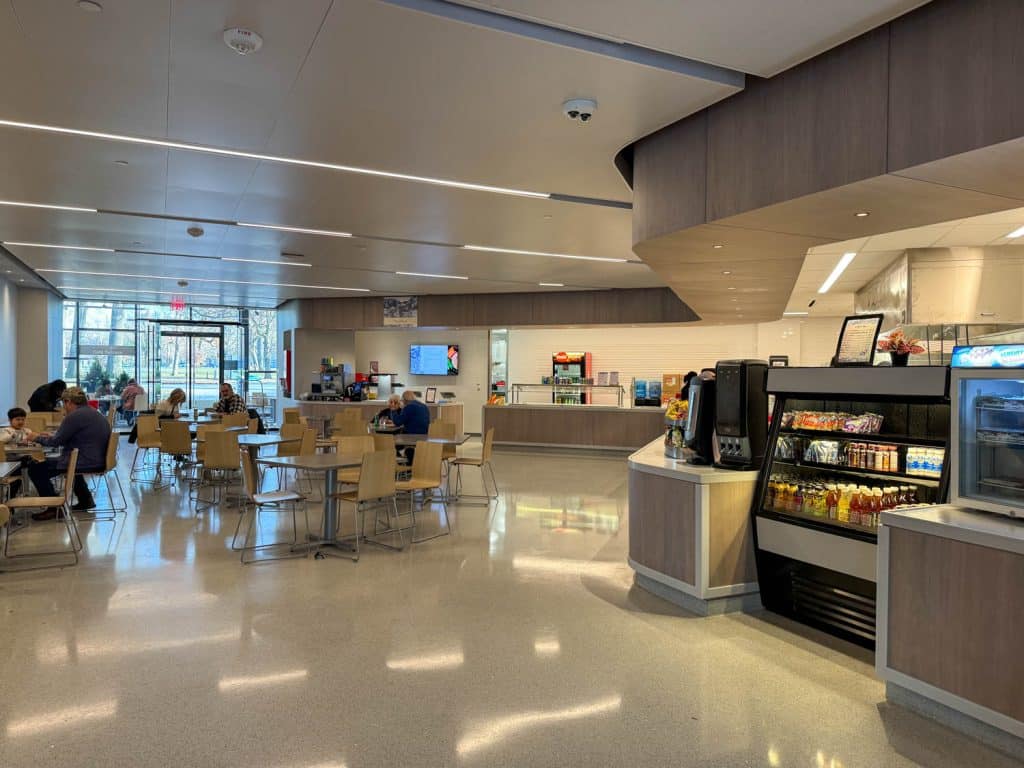
2. Hungry? Check out the Origins Cafe
The Cleveland Museum of Natural History has its own cafe with lots of food options and ample seating both in the main cafe space, and in a small atrium.
You can order things like healthy bowls, pretzels, and burgers, or pick up a salad or wrap.
3. Plan your visit in advance
The Cleveland Museum of Natural History isn’t a huge museum like the Cleveland Museum of Art is. However, you’ll still want to plan out your visit a little before you go, especially since you can save some money on tickets if you book them online in advance.
The Cleveland Museum of Natural History is open from 10 a.m. to 5 p.m. Tuesday through Sunday.
- If you have 1 hour: Select several exhibits from the main highlights from the list above.
- If you have 2 hours: You can likely see almost everything but a little more rushed. You could also see everything on the main floor and the Perkins Wildlife Center easily in 2 hours.
- If you have 3+ hours: You’ll easily be able to enjoy what every exhibit has to offer in 3+ hours, including the Smead Discovery Center, Perkins Wildlife Center, all the permanent and the temporary exhibits, and find those Easter eggs!
4. Check out cool events
There always seems to be something happening at the Cleveland Museum of Natural History! One of my favorite things to enjoy is their Think & Drink with the Extinct events. What is known as “Cleveland’s brainiest happy hour,” it happens generally once per quarter.
The events are 21+ and usually include local beer and wine, as well as lots of interactive and fun exhibits all matching a theme for that event.
5. Weddings at the Cleveland Museum of Natural History
Did you know you can get married here?! It’s actually where my husband, Chris, and I got married in 2018! We had the ceremony in the Wade Oval Lobby, had happy hour with Balto, and partied under the dinos all night! It was incredible and such a fun idea!
Our guests enjoyed the exhibits, took a ride on the earthquake simulator, and loved partying among the prehistoric animals. It was such a good time, and I highly recommend it! You can check out their page here for more details!
With all of these tips, you’ll definitely have a great visit to the Cleveland Museum of Natural History!
READ NEXT: Visiting the Cleveland Museum of Art: 9 Things You Have to See
Have you visited the Cleveland Museum of Natural History? What is your favorite thing to see there?

Kat is a Cleveland transplant and has lived here for over 5 years. She loves to eat, drink, and explore all across the city, and has made it her personal mission to find the best breweries and pizza in Northeast Ohio. She also runs a couples travel blog and podcast called World Wide Honeymoon.